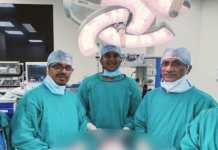


Rare Pulmonary Condition Successfully Treated at Father Muller Medical College and Hospital
Mangalore: A 38-year-old male patient was admitted to Father Muller Medical College and Hospital after being diagnosed with right lower limb deep vein thrombosis (DVT). He had a history of breathlessness, and his oxygen saturation at rest was less than 80% on room air, requiring continuous oxygen through a face mask.
He was further evaluated to determine the cause of his desaturation through a detailed 2D echocardiography performed by Dr. Prabhakar H., Interventional Cardiologist. The evaluation revealed severe pulmonary arterial hypertension (PAH) with severe right-sided valvular leak (TR), an indirect indication of chronic thromboembolic pulmonary hypertension (CTEPH). This diagnosis was confirmed by computed tomography pulmonary angiography (CTPA).

CTPA revealed complete occlusion of the left pulmonary artery with no blood flow to the left lung, indicating a chronic left pulmonary thromboembolism associated with a severe, complex, and life-threatening cardiopulmonary condition.
Given the severity of the disease and the risk of progressive heart and lung failure, the medical team opted for definitive surgical intervention. The patient underwent a left surgical pulmonary thromboembolectomy under total circulatory arrest (TCA) on 17 January 2026, performed under general anesthesia.
The surgery was successfully performed by Dr. Anand K. T., Cardiothoracic and Vascular Surgeon, with expert anesthetic management provided by Dr. M. M. Chetana Anand, Cardiac Anaesthesiologist, and comprehensive Cardiology support from Dr. H. Prabhakar, Dr. Pradeep Pereira, Dr. Jostol Pinto, and Dr. Ashok Jain. The procedure required advanced surgical expertise and meticulous perioperative coordination.

Following surgery, the patient was managed in the Intensive Care Unit (ICU), where he received continuous monitoring and specialized postoperative care. His recovery during the ICU stay was stable and satisfactory, with significant clinical improvement. At present, the patient is off oxygen and maintains an oxygen saturation of 95%.
This successful outcome highlights the importance of early diagnosis, multidisciplinary collaboration, and advanced cardiothoracic surgical capabilities in the management of complex pulmonary vascular diseases.
Pulmonary Thromboembolectomy
Pulmonary thromboembolectomy is a specialized medical procedure used to remove dangerous blood clots from the arteries of the lungs. It is typically considered a life-saving intervention for patients whose condition is too severe to be treated by standard blood-thinning medications alone.
Why Is It Performed?
The procedure is used to treat two primary conditions:
1. Acute Massive Pulmonary Embolism (PE): A sudden, large blood clot that causes immediate heart and lung failure.
2. Chronic Thromboembolic Pulmonary Hypertension (CTEPH): A long-term condition in which old blood clots transform into permanent scar tissue, blocking blood flow and causing high pressure in the pulmonary arteries.
Types of Procedures
As of 2026, there are two main methods for removing these clots:
1. Surgical Thromboembolectomy (Open-Heart Surgery)
• How it works: Surgeons open the chest through the breastbone (sternum) to access the heart and lungs.
• Bypass machine: A heart-lung machine maintains circulation during surgery.
• Process: An incision is made in the pulmonary artery, and clots are manually removed.
• Duration: Surgery typically lasts 4 to 6 hours.
• Cooling: In complex cases, the body is cooled significantly (profound hypothermia) to protect the brain while blood flow is temporarily stopped, allowing better visualization of the arteries.
• Hospital stay: Patients usually spend 2 to 3 days in the ICU, followed by an additional 7 to 10 days in the hospital for recovery.
2. Mechanical/Percutaneous Thrombectomy (Minimally Invasive)
• How it works: A thin catheter is inserted through a small puncture in the groin or neck and guided to the lungs.
• Removal: The device either fragments the clot or removes it using vacuum-assisted suction.
Risks and Benefits
• Benefits: The procedure can be curative for CTEPH, resulting in immediate improvement in breathing, heart function, and physical activity. In acute cases, it can prevent sudden death.
• Risks: As with any major procedure, risks include bleeding, infection, cardiac arrhythmias, or lung injury. However, the surgical mortality rate has significantly decreased and is now as low as 1–2% at specialized centers.
Recovery and Long-Term Care
• Medication: Most patients require lifelong anticoagulation therapy to prevent new clot formation.
• Monitoring: Regular follow-up with cardiologists or pulmonologists is essential to monitor pulmonary pressures and overall heart health.