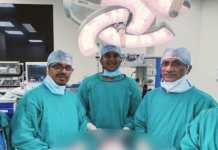


Expert Care Helps 29-Week High-Risk Pregnancy End in Success at KMC Hospital Attavar
Mangaluru: Doctors at KMC Hospital Attavar successfully managed a very high-risk pregnancy and helped both mother and baby return home safely after nearly two and a half months of hospital care.
A 37-year-old woman, who was 26 weeks and 5 days pregnant, visited the hospital for her routine antenatal check-up. She had a difficult obstetric history — one abortion 11 years ago and a previous cesarean section 4 years ago due to severe high blood pressure during pregnancy, when, unfortunately, the baby did not survive. She had no living children.
During regular check-ups with Dr. Nina Mahale, Consultant Obstetrician and Gynaecologist, she was found to have very high blood pressure and was admitted on 28.11.2025. Further tests showed two serious complications: Complete placenta previa (Grade 4) – a condition where the placenta completely covers the mouth of the uterus, which can cause severe bleeding, and Severe fetal growth restriction – the baby was much smaller than expected for the stage of pregnancy.
She was started on medicines to control blood pressure and given steroid injections to help the baby’s lungs mature. Regular ultrasound and Doppler scans were carried out to closely monitor the baby’s growth and blood flow. An MRI scan showed that part of the placenta was abnormally attached to the uterus (placenta accreta), increasing the risk of heavy bleeding during delivery.
On 13.12.2025, scans showed that the baby’s condition had worsened, with Doppler showing reversed blood flow in the umbilical cord. At 29 weeks of pregnancy, as the mother’s blood pressure remained uncontrolled, the medical team decided to perform an emergency cesarean section on 16.12.2025.
A baby girl weighing 690 grams was delivered. The baby was immediately taken over by the pediatric team for specialized care in the neonatal unit.
During surgery, doctors found that the placenta was abnormally stuck to the uterus in two places. The team carefully removed it, controlled bleeding with special stitches, and transfused one unit of blood. The mother’s recovery after surgery was smooth.
The patient was closely monitored in the labour ward under the care of Dr. Nina Mahale and the Obstetrics and Gynaecology team, including Dr. Aparna Rajesh Bhat (Unit Chief), Dr. Sauda (Associate Professor), Dr. Rakshitha (Senior Resident), postgraduate doctors, and nursing staff.
A multidisciplinary team approach involving the Departments of Obstetrics & Gynaecology, Medicine, Radiology, Pediatrics, Pulmonary Medicine, and Anesthesia was instrumental in achieving a successful outcome. The hospital management also extended strong support throughout the process.
Despite the extremely high-risk nature of the pregnancy, the team carefully prolonged the pregnancy under strict supervision until 29 weeks to give the baby a better chance of survival.
After nearly two and a half months of hospital stay, both mother and baby were discharged in good health on 17 February 2026. At the time of discharge, the baby weighed 1.49 kg.
This case highlights the importance of early detection, close monitoring, and coordinated team care in managing high-risk pregnancies.